
Global optimization for refinery and chemical planning
Find the plans local solvers miss. Answer every what‑if in under a minute.
One model of the plant for engineers, planners and traders, built to replace the planning LP, the process simulator and the spreadsheets between them.
- Global optimumon every classic pooling benchmark with a known optimum
- Same planevery time, so a case delta is the scenario, not the solver
- GPUaccelerated, built for the largest models
The platform
Replace three tools with one model of the plant.
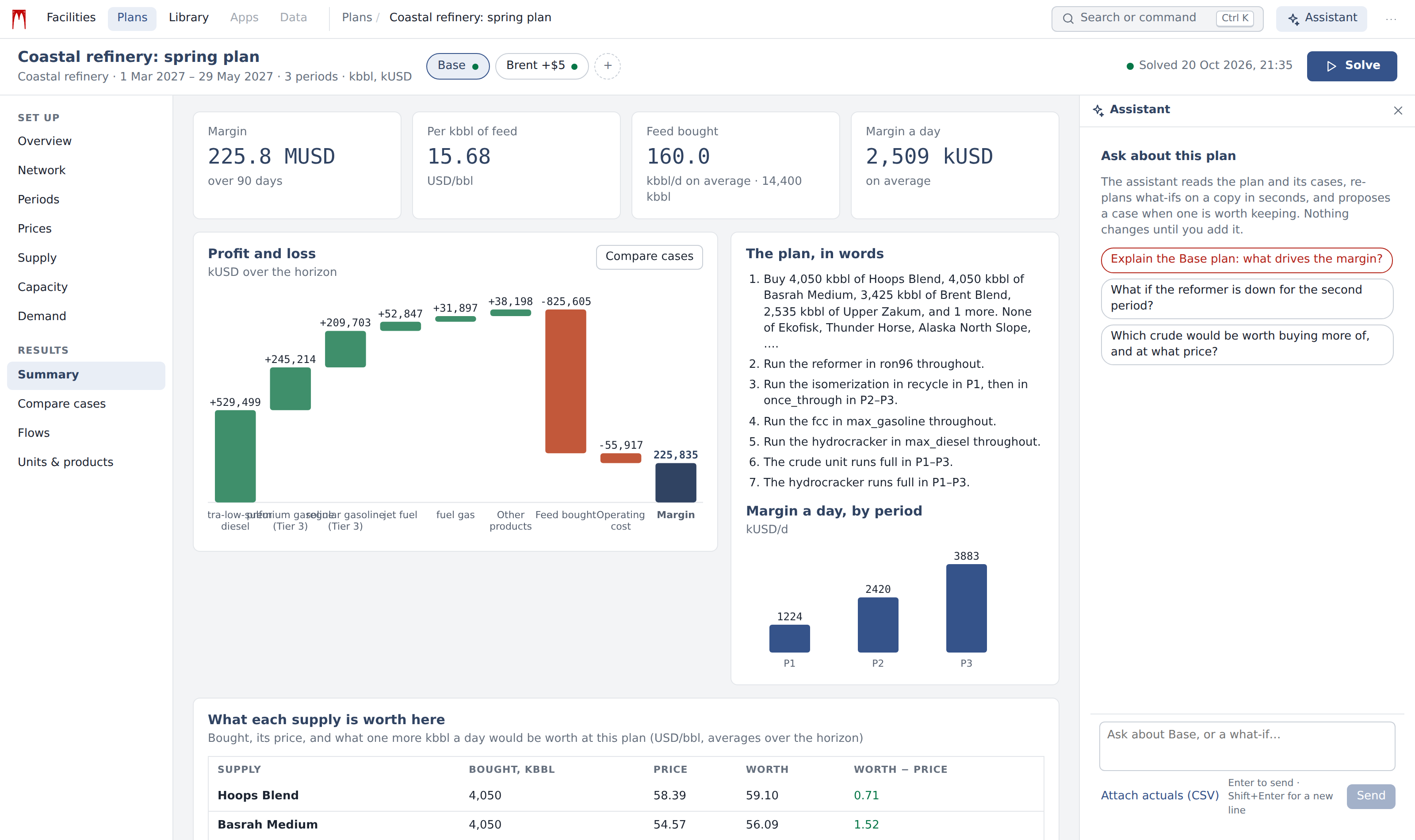
Each group keeps the view it works in. Underneath, there is one model: the planner's yields come from the flowsheet the engineer solves, and the trader's numbers come from the plan.
Instead of Aspen PIMS or AVEVA Spiral Suite
Plans
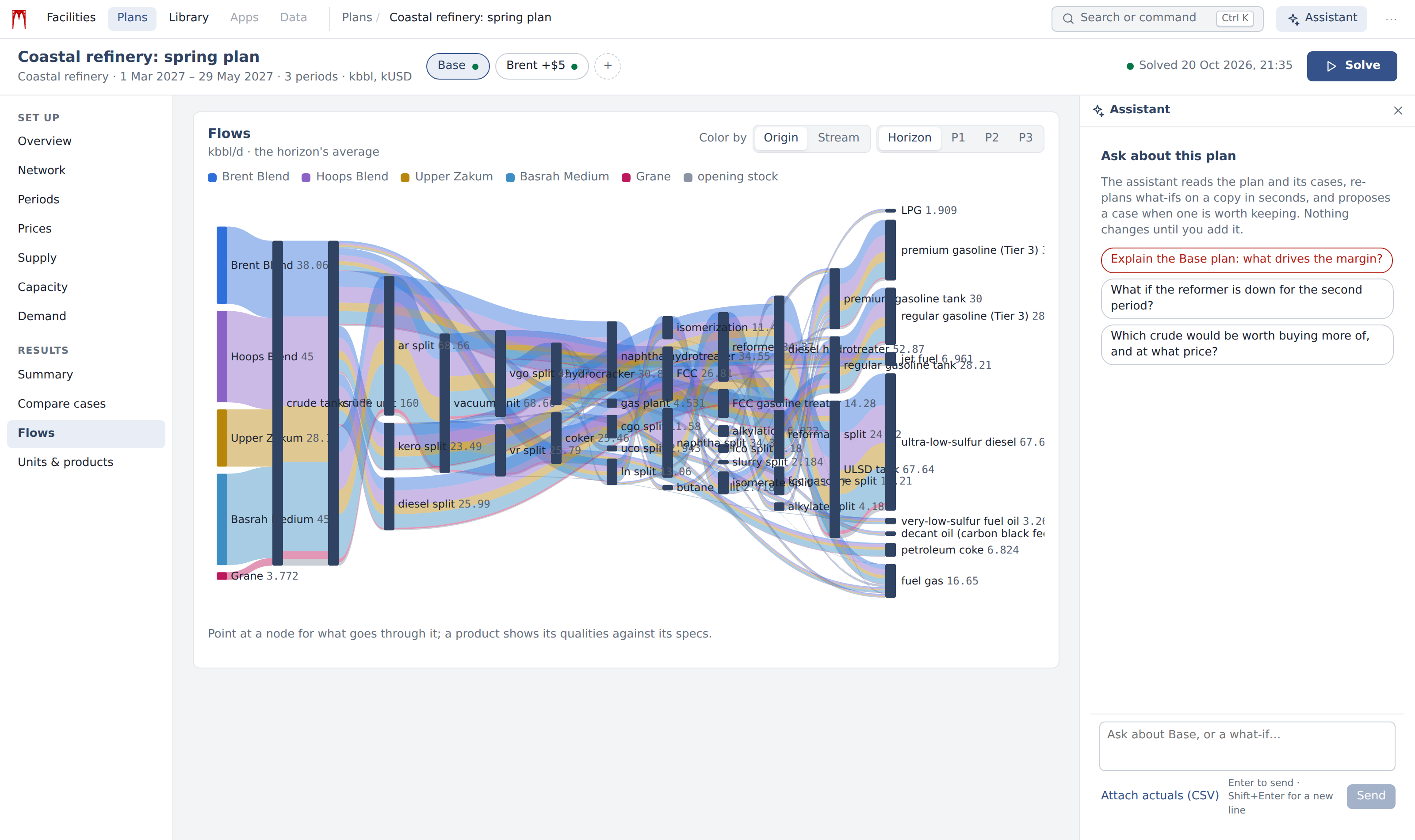
Multiperiod, multisite planning with cases, price markers and turnarounds you drag. Solved by an engine built for pooling and blending, not by recursion from a starting guess.
Instead of Aspen Plus, Aspen HYSYS or AVEVA PRO/II
Facilities
Flowsheets that solve, simulate and optimize, steady-state or dynamic, in the browser. Operating modes for the plan are generated from the flowsheet's own solves, so the yields come with them and nobody re-keys them.
Instead of copies in Excel
Apps coming
Views for traders and analysts on the same plan: crude valuation, scenarios, marginal values. They run cases and read results; they never fork the model.
Plan the way the market moves
Prices follow markers, so "Brent up $5" moves every crude at once. Paste prices from Excel or drag them on the chart. Turnarounds are bars you drag and stretch. Everything is entered by day; periods are only how the plan is solved, so you can change them at any time.
Build once, share everywhere
Unit models, materials, assays and product grades live in one library, shared across every facility and plan. Nothing in the core is refinery-only: the same platform handles chemicals and lubricants.
The assistant, beside every view
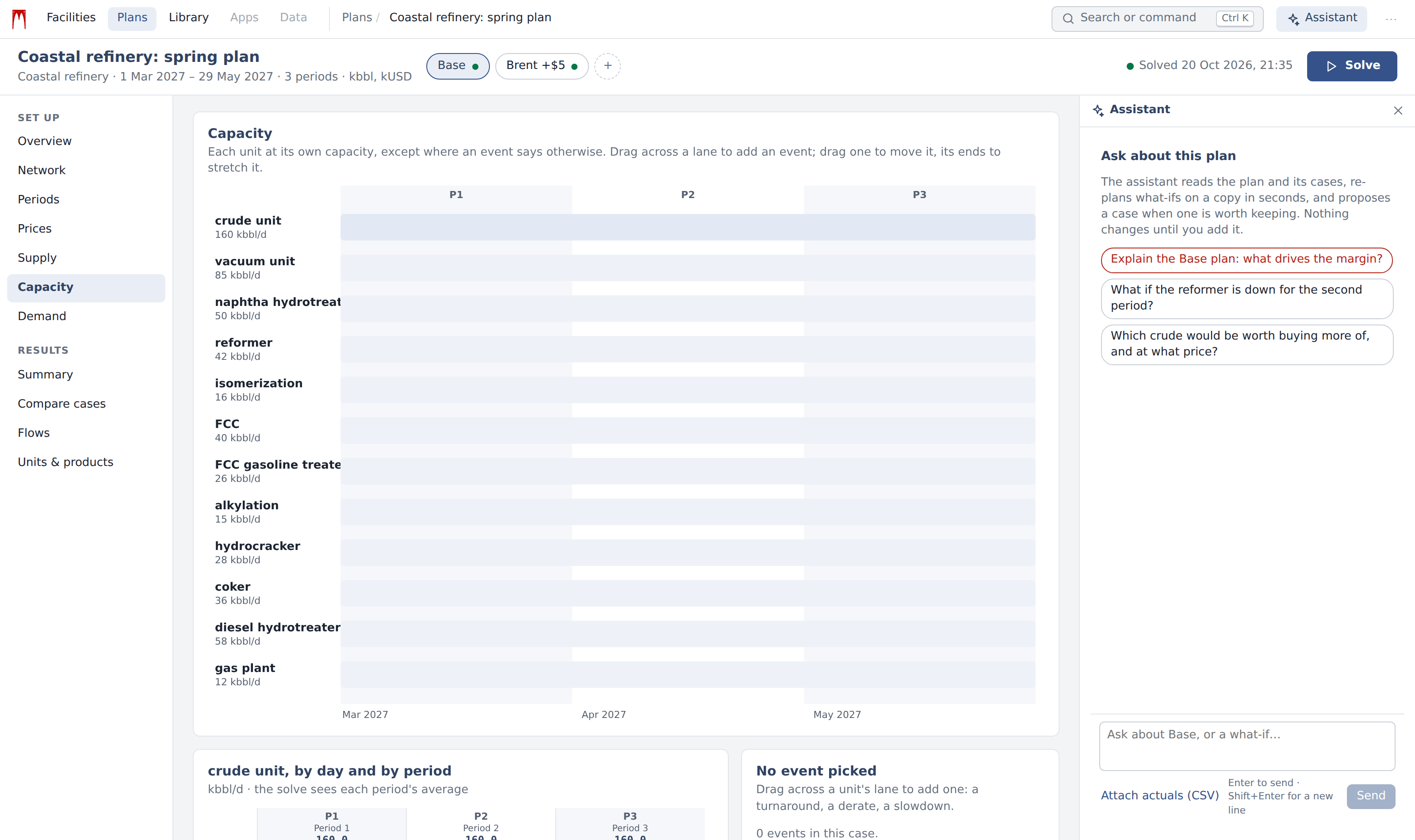
Anything you can do by clicking, you can also do by asking. The assistant reads the plan, tries changes on a copy and proposes a case. Nothing changes until you accept it.
A planner's week
Four requests, four answers, each in under a minute.
On a synthetic Gulf Coast conversion refinery: 160 kbbl/d, 12 crudes, three months. Each request is re-planned from the solved plan and ends as a case the planner can keep.
-
Monday
An email from operations
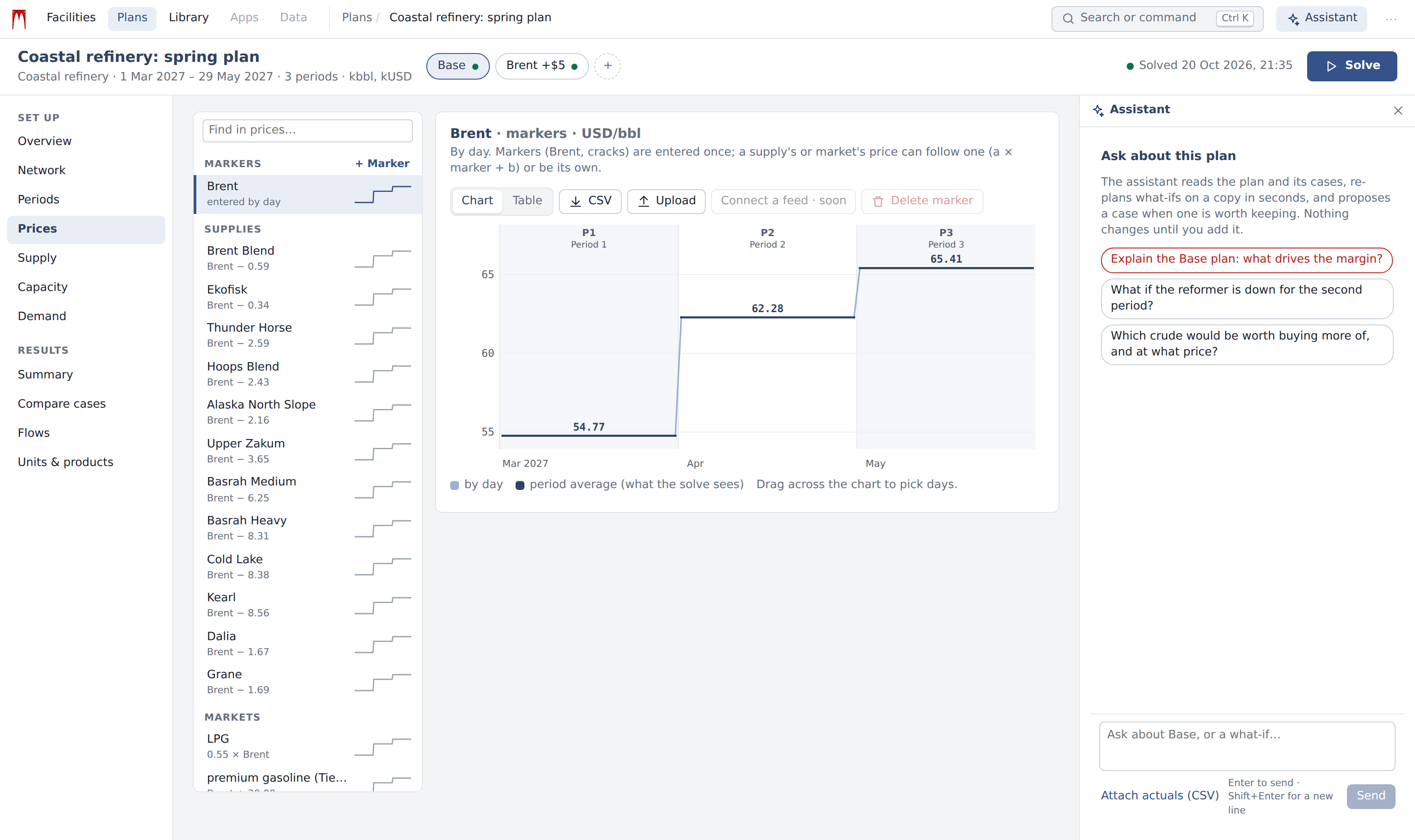
"The reformer will be down for the second period for a catalyst change." The assistant sets up the turnaround, re-plans and explains what it costs and why. The turnaround shows up in Capacity as a bar, just as if the planner had drawn it.
-
Tuesday
An offer from a trader
"Basrah Heavy at $3/bbl below its usual price. Take it?" The assistant tries the offer on a copy and answers yes or no, with the amount. The plan stays as it was.
-
Wednesday
Actuals from the plant
Attach the first week's file. The assistant holds the days that already happened and re-plans the rest of the horizon from them.
-
Thursday
A question before the planning meeting
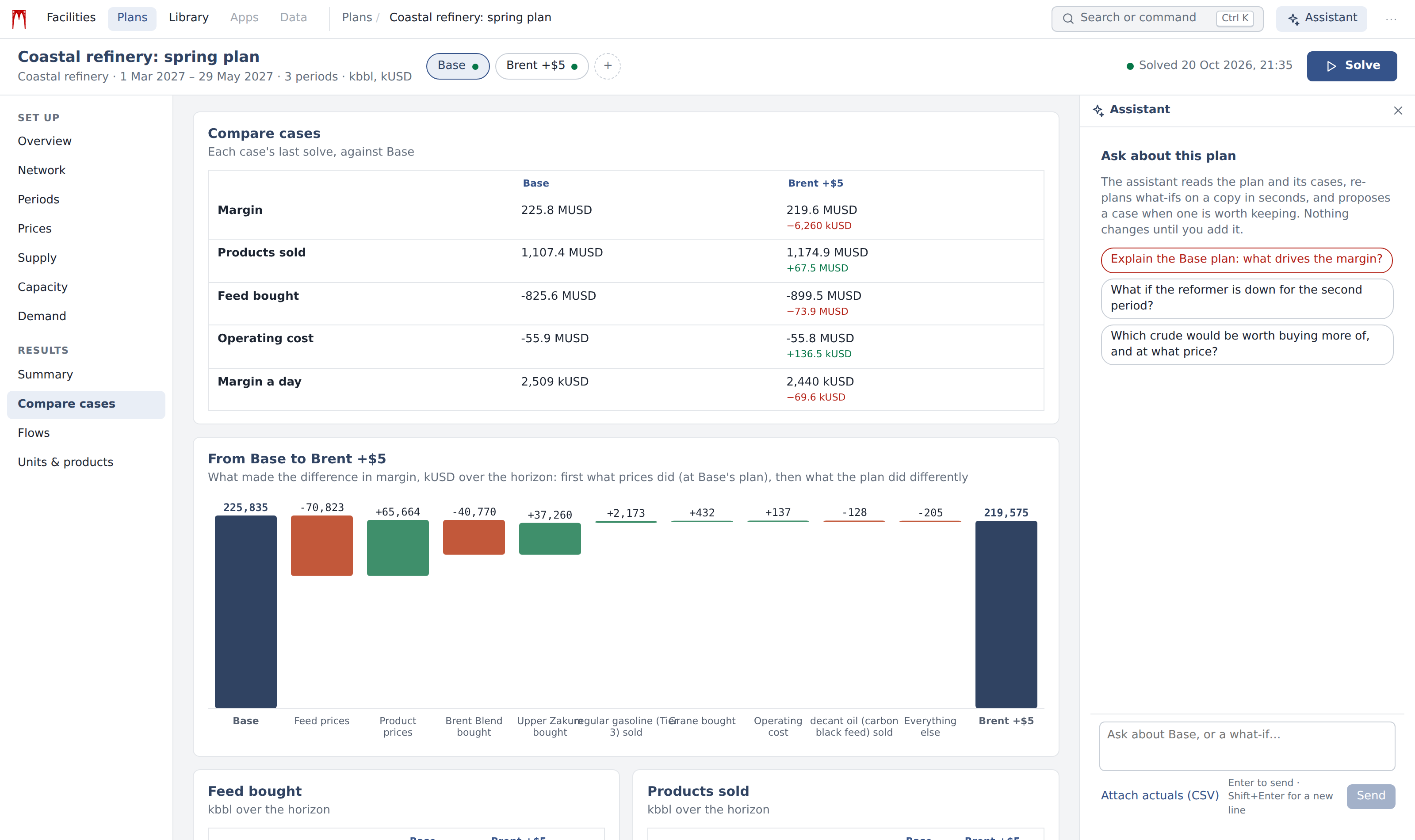
"What limits us, and how does the turnaround compare with Base?" The assistant gives notes for the meeting and the margin's bridge, line by line.
The same week today
Three groups, three tools, three versions of the same plant.
Engineers
Model the plant rigorously. Nobody downstream uses it.
Planners
Plan in a separate model, kept by hand and refreshed every few months. Each case takes minutes to hours, so few what-ifs get asked, and they get answered late.
Traders and analysts
Work on their own copy of the numbers, pasted from last week's run.
Every gap between those three versions costs money: a plan built on stale yields, or a cargo offer answered a day late.
The solver
Better plans, and the same plan every time you ask.
Blending and pooling make refinery planning nonconvex: a pool's quality depends on what flows into it, and every downstream spec depends on that quality. The pooling problem is NP-hard and has been studied for nearly 50 years, from Haverly (1978) to Ben-Tal et al. (1994) and Adhya et al. (1999). Local methods such as SLP and distributive recursion climb from a starting guess and stop at the first optimum they reach, and on the report a local optimum looks exactly like the true one.
What-ifs that don't add up
Adding a constraint can only cost money, or leave the margin where it was. With a local optimizer, it can come back better: the new case just landed on a better local optimum than the base did. So every case-versus-base delta mixes the scenario's real effect with the solver's luck, and the planner can't tell which is which. A turnaround that "makes money" or a cargo that "costs nothing" is the solver talking, not the plant.
Our own search method, not an off‑the‑shelf solver
Today’s planning tools hand the hard part to a general-purpose solver: SLP or distributive recursion in PIMS-class tools, IPOPT, CONOPT or a generic global solver elsewhere. Those solvers know nothing about refineries. Local ones stop at the first optimum they reach. Generic global ones can prove an optimum on small models, but on a full refinery plan they can run out of time well short of the best plan.
We wrote our own. It is built on the structure of the plant itself, starts from a much tighter view of where the best plans are, and explores many directions at once, in parallel, on CPUs and GPUs.
Off-the-shelf solvers
- General purpose: blind to the plant's structure
- Climb from one starting guess
- Stop at the nearest local optimum
- Answer changes with the guess, or the model's order
The Prometheus search
- Purpose-built for planning: uses the plant's structure
- Starts from a tight view of the whole problem
- Explores many directions in parallel, on CPU and GPU
- Same plan every time, so case deltas are real
Start with a pilot
Keep PIMS. Give it a better place to start.
Aspen PIMS stops at the local optimum nearest its starting point, which is why planners spend so much time tuning initial guesses (PGUESS), and why the answer can change when the guesses do. Give it a better starting point and it finds a better plan, in your own model.
-
Step 1
Install it where your model lives
On your own servers or in your own cloud tenant. Your model, prices and plans never leave your network.
-
Step 2
Run the global search
The engine reads your PIMS model as it is today and searches the whole nonconvex problem, not just the neighborhood of your current guesses.
-
Step 3
Get a PGUESS
The plan comes back as initial values for the recursed qualities, ready to load into PIMS.
-
Step 4
See the margin in your own numbers
Run PIMS from the new starting point and compare the objective with your current plan. Same model, same solver, your own reports.
Your model stays yours
- Runs entirely inside your network: on premises or in your private cloud.
- No data leaves your environment, and nothing is sent to us.
- Not convinced yet? We first show the benefit on a public refinery model, then you run the same check on your own model, behind your firewall.
No migration, no new workflow, no leap of faith: the benefit shows up in the tool your planners already trust.
For engineers
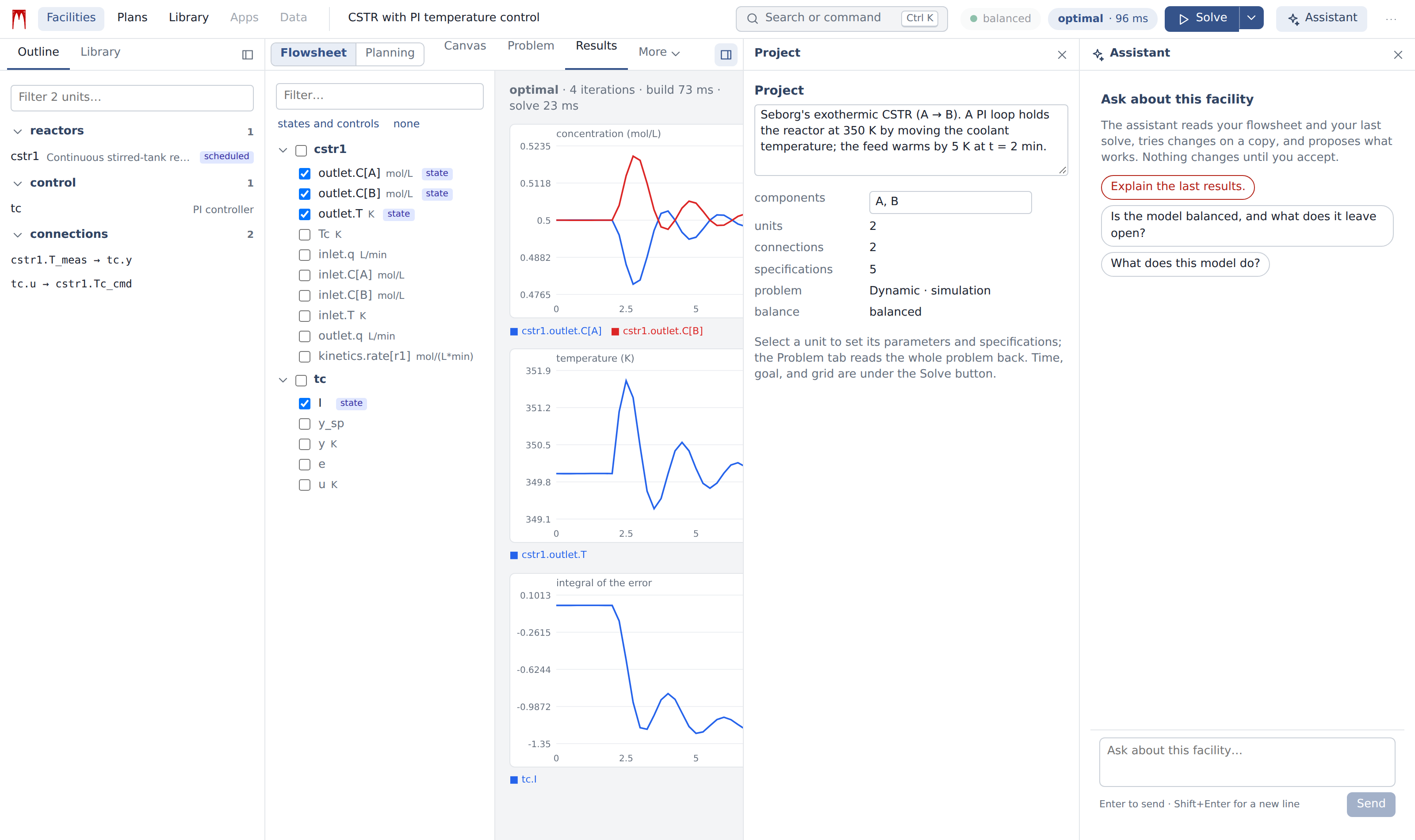
The flowsheet is the model, not a drawing of it.
- One document: the canvas, tables, model text and results are all views of it.
- Any value can be held fixed or released to the optimizer within a range. The same model simulates, optimizes and runs dynamically, with no separate optimization blocks.
- Degrees of freedom and diagnostics are always visible. When a solve fails, the assistant diagnoses it and proposes a fix it has checked by solving.
- Your solves become the planner's operating modes, so the plan starts from the plant.
- Everything has a URL, and everything the mouse can do, Ctrl+K can do.
Roadmap
Coming next.
Bring your PIMS model coming
Import an existing PIMS model as is, with its units, modes and blend specs, and run it side by side with the plan you trust today. Nothing is rebuilt by hand.
Planning models that keep themselves current
The plant model generates the planning model across its whole operating range, shows the fit error and flags a mode when the flowsheet has changed under it.
Apps and live data
Views for traders and analysts on the same model, plus live plant and market data feeds.
About us
Scientists and planners who got tired of waiting for the answer.
Our mission
Our mission is to provide cutting-edge technology solutions that help our customers maximize their margins and achieve their operational, trading, compliance, and environmental goals. We measure our success by the tangible benefits we deliver to our customers.
Our story
For years, the energy industry has been forced to rely on antiquated software that's slow, obscure, and painful to work with. The science behind these tools is often incorrect, providing suboptimal plans and incorrect price signals. As scientists, experienced industry professionals, and technology experts, we knew there had to be a better way.
We founded our company to provide cutting-edge technology solutions that help energy and chemical companies maximize their profit margins and make better decisions. Our software is built on the latest technology and sound scientific principles, and we're committed to continuous improvement to stay ahead of the curve.
We don't just sell software; we provide tangible benefits that make a real difference in our customers' bottom line.
Experienced leadership
Our leadership team brings decades of experience in both the tech and energy industries.
In the tech industry, our leaders have worked with the world's leading companies, developing technology to design distribution networks and optimize supply chain operations.
In the energy industry, our leaders have led successful projects to improve raw material valuation and acquisition. They have been instrumental in the development of optimization technology in the operation of midstream and downstream.
With their combined expertise in both the tech and energy industries, our leadership team is uniquely qualified to lead our company as we work to create cutting-edge technology for our customers.
Get started
See it on your own refinery.
Book a live demo. When you want to see it on your own model, start a pilot: it runs inside your network, and your data never leaves it.